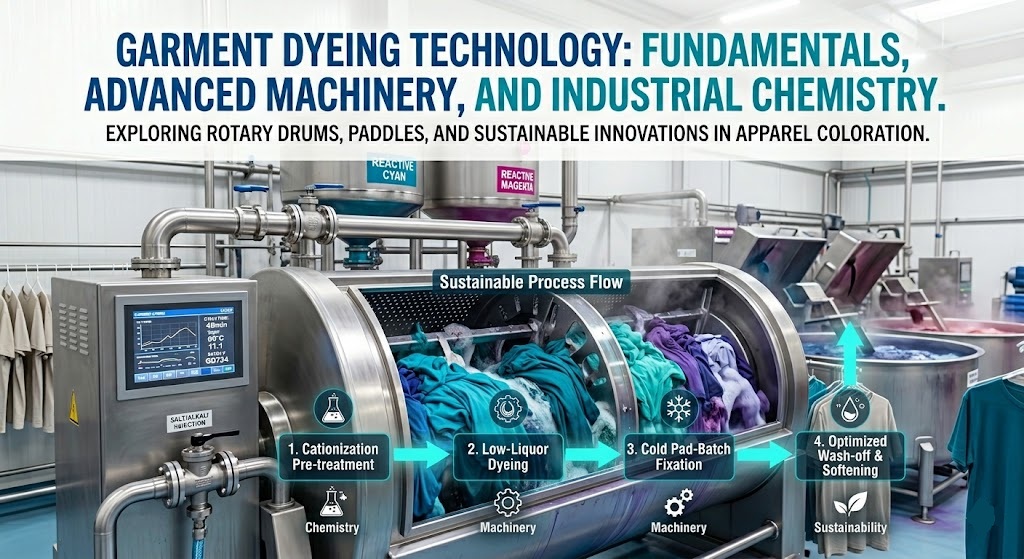
Garment dyeing technology—the process of coloring fully constructed apparel rather than yarn or fabric rolls—is a vital, high-flexibility pillar of the modern global fashion supply chain. As the consumer market moves rapidly toward ultra-fast fashion cycles, real-time demand-driven inventory, and personalized apparel, traditional methods of processing colored textiles are facing logistical bottlenecks.
Conventional methods like yarn dyeing and piece (fabric) dyeing require brands to commit to specific color trends up to six to nine months in advance. Garment dyeing shifts this critical decision to the final phase of production. By manufacturing garments in an uncolored state—known as “greige” or Prepared for Garment Dyeing (PFD) form—and adding color only after final orders are confirmed, manufacturers can cut lead times down to a few days.
This comprehensive operational guide explores the deep engineering mechanics, polymer chemistry, sophisticated machinery configurations, defect resolution protocols, and advanced global research transforming garment dyeing into a highly efficient, sustainable operation.
1. Underlying Philosophy and Economic Advantages of garment dyeing technology
The foundational philosophy of garment dyeing centers on post-manufacturing postponement. In traditional textile workflows, risk increases at every upstream processing stage. Committing thousands of meters of yarn or fabric to a highly specific, trend-dependent color shade risks massive financial losses if consumer demand shifts.
Traditional Textile Sequence:
Yarn/Fabric Dyeing ──> Cutting ──> Sewing ──> Finished Inventory (High Color Risk)

Garment Dyeing Sequence:
Greige Fabric ──> Cutting ──> Sewing (PFD) ──> Demand Signal ──> Garment Dyeing (Low Color Risk)
Strategic Industrial Advantages
- Rapid Market Responsiveness: Brands can monitor real-time sales indicators and dye PFD inventory into trending colorways within 48 to 72 hours, matching immediate seasonal shifts.
- Minimization of Unsold Inventory: Overproduction of unpopular shades is virtually eliminated. Leftover PFD garments can simply be held or dyed into safe, perennial baseline colors like black, navy, or charcoal.
- Elimination of Fabric Waste Discards: In piece-dyed manufacturing, the scrap fabric left over after cutting patterns (typically 15% to 25% of total fabric volume) consists of fully dyed material. This represents wasted dyestuff, chemical auxiliaries, water, and energy. In garment dyeing, these scraps are raw greige PFD fibers, meaning zero spent dyestuff or fixation chemicals are thrown away in the cutting room.
- Unique Aesthetic Finishes: The mechanical action within garment dyeing machinery naturally softens seams, relaxes fabric tension, and allows for specialized vintage, distressed, or uneven wash effects (e.g., Old-Effect, acid wash, pigment wash) that are impossible to duplicate via piece-dyeing methods.
2. PFD (Prepared for Garment Dyeing) Specifications and Pre-Treatment Protocols
The success of a garment dyeing run depends almost entirely on the quality of the raw, un-dyed garment. Any structural variation, chemical impurity, or structural tension present in the garment before it enters the dye bath will be magnified during the dyeing process. Therefore, strict adherence to PFD engineering criteria is mandatory.
       ┌────────────────────────────────────────────────────────┐
       │             PFD Pre-Treatment Sequence                 │
       └───────────────────────────┬────────────────────────────┘
                                   ▼
       ┌────────────────────────────────────────────────────────┐
       │   Singeing & Desizing (Enzymatic Starch Degradation)   │
       └───────────────────────────┬────────────────────────────┘
                                   ▼
       ┌────────────────────────────────────────────────────────┐
       │ Scouring (Saponification of Natural Oils, Waxes, Fats) │
       └───────────────────────────┬────────────────────────────┘
                                   ▼
       ┌────────────────────────────────────────────────────────┐
       │   Hydrogen Peroxide Bleaching (Base Whiteness Index)   │
       └───────────────────────────┬────────────────────────────┘
                                   ▼
       ┌────────────────────────────────────────────────────────┐
       │  Tensionless Drying & Stress Relaxation (Shrinkage)    │
       └────────────────────────────────────────────────────────┘
Dimensional Stability and Shrinkage Management
Because garments undergo intense mechanical tumbling and thermal stress in an aqueous environment during dyeing, they experience significant relaxation shrinkage.
- Fabric Selection: Fabrics must be knitted or woven with precise tension controls. Woven fabrics must undergo thorough sanforization (mechanical compressive shrinkage), and knits must be compactly processed.
- Pattern Engineering: Garment pattern designers must apply differential scaling factors. Patterns are intentionally oversized—often by 4% to 10% in length and width depending on the fiber construction—to account for the shrinkage that occurs in the hot dye bath.
- Stress Relaxation: PFD garments should ideally be washed or stress-relieved before assembly to ensure that individual panels do not warp or twist un-evenly during the final color stage.
Cutting and Sewing Quality Matrix
- Sewing Thread Compatibility: The sewing thread must match the exact fiber morphology and polymer type of the garment panels. If a 100% cotton t-shirt is sewn with standard polyester thread and then dyed with reactive dyes, the cotton panels will absorb the color while the polyester thread remains bright white. For solid color matching, 100% mercerized cotton thread must be used on cotton garments. Alternatively, designers can specify polyester thread intentionally to create a contrasting seam effect.
- Thread Tension Optimization: High sewing machine tension creates compressed, tightly packed seams. During dyeing, the liquor cannot penetrate these packed boundaries, yielding un-dyed white lines inside the folds—a defect known as seam pale-stripes. Seams must be loose yet secure, maximizing liquor circulation.
- Trims and Accessories: Zippers, buttons, rivets, and brand labels must be rated to withstand boiling water temperatures ($100^\circ\text{C}$ or up to $130^\circ\text{C}$ for synthetics) and highly alkaline or acidic pH ranges without cracking, melting, or corroding. Non-corrosive plastics or treated brass are typical industrial requirements.
Chemical Pre-Treatments
Before assembly, the base textile must undergo an intensive preparation sequence to remove hydrophobic impurities that would otherwise block dye liquor absorption:
- Desizing: Complete degradation of starches, polyvinyl alcohol (PVA), or polyacrylates applied during weaving using highly specific amylase enzymes.
- Scouring: The extraction of natural waxes, pectin, proteins, and residual lubricating oils via hot saponification using sodium hydroxide NaOH and high-performance non-ionic surfactants. This raises fabric water-absorbency to under two seconds per drop.
- Bleaching: Oxidative eradication of natural pigments (such as carotene in cotton) utilizing hydrogen peroxide (H2O2) regulated by sodium silicate stabilizers at a pH of 10.5 to 11.0. This guarantees a uniform baseline whiteness index across all components, preventing metamerism or muddy color renditions.
3. Classification of Garment Dyeing Machinery
Modern industrial garment dyeing relies on mechanical agitation to distribute dye molecules evenly across complex, multi-layered structural shapes. Unlike fabric or yarn dyeing, where the substrate is kept under constant tension, garment dyeing machines process loose, free-tumbling structures.
A. Rotary Drum (Horizontal Cylinder) Machines
The rotary drum design is the industry workhorse for processing constructed garments. It consists of a perforated horizontal inner drum housed inside a robust, pressurized or non-pressurized stationary outer shell.
                     Outer Stationary Shell
                   ┌──────────────────────────┐
                   │   ┌──────────────────┐   │
                ┌──┼───┤   Lifter/Baffle  ├──┼──┐
                │  │   └──────────────────┘   │  │
                │  │  Garments                │  │
    Drive Axle ─┼──┼─  o   o    o     o    ──┼──┼─ Driven Bearings
                │  │    o    o    o    o      │  │
                │  │   ┌──────────────────┐   │  │
                └──┼───┤   Lifter/Baffle  ├──┼──┐
                   │   └──────────────────┘   │
                   └──────────────────────────┘
                        Dye Liquor Level
              =====================================
- Mechanical Architecture: The inner cylinder features internal longitudinal ribs or lifters (baffles). As the cylinder rotates, these lifters lift the garments out of the dye liquor and drop them back into the bath via gravity at the top of the rotation cycle.
- Operational Parameters: To minimize structural distortion and surface abrasion, the rotation direction alternates regularly (e.g., 3 rotations clockwise, 2 seconds pause, 3 rotations counter-clockwise). Rotational speed varies between 5 and 35 RPM based on fabric sensitivity.
- Liquor Ratios (L:G): Historically high at 1:15 to 1:20, modern advanced rotary drums feature tight profiles and internal shell engineering that cut liquor ratios down to 1:6 or 1:8, saving massive volumes of water and thermal energy.
B. Paddle Dyeing Machines
Paddle machines are reserved for high-volume, low-stress processing of delicate items, including fine knitwear, sweaters, wool blends, and hosiery. They avoid the aggressive drops of rotary drums.
Horizontal Paddle (Overhead Paddle) Machines
The design features a large open-top rectangular vat equipped with a motorized paddle wheel mounted horizontally above the liquor surface.
- Kinematics: The paddle blades dip roughly 5 to 10 centimeters into the top of the fluid level. The continuous rotation of the paddle generates a gentle, surface-driven loop current within the oval vat.
- Fabric Interaction: The garments circulate through the long racetrack configuration of the vat, propelled by the surface wave motion. Mechanical impact between the paddle blades and the garments is minimized, significantly lowering the risk of fiber hairiness, pilling, or felting.
- Liquor Ratios: These systems operate at high liquor ratios ranging from 1:30 to 1:40, demanding a larger chemical footprint per kilogram of substrate.
Lateral Paddle (Side-Paddle) Machines
In this variation, the paddle wheel is mounted vertically onto one side of the vat wall.
- Fluid Dynamics: The side paddle generates a horizontal vortex flow, spinning the garments along a horizontal path around a central island barrier.
- Process Intent: This system maintains constant, gentle kinetic energy throughout the bath, making it ideal for delicate wool, mohair, and acrylic blends where high temperatures and mechanical impacts would cause irreversible shrinkage or fiber degradation.
C. Advanced Low-Liquor Ratio (LLR) Air-Jet & Soft-Flow Garment Washers
The latest high-tech upgrade in garment processing combines the principles of fabric jet-dyeing with rotary washing mechanics.
- Atomization Principles: Rather than submerging garments in a deep bath, these high-efficiency machines use fine high-pressure internal spray nozzles to atomize the dye liquor directly onto the tumbling garments.
- The Power of Compressed Air/Eco-Drives: The garments are continuously tumbled via smart electronic drum drives while a high-velocity air stream or dynamic liquor stream moves the garments gently through the drum space.
- Resource Efficiency: These systems achieve liquor ratios as low as 1:3 to 1:5, reducing fresh water consumption by up to 70%, chemical salt demands by up to 60%, and steam energy requirements for heating by over 50%.
4. Dye Selection and Fiber-Specific Chemical Engineering
Achieving uniform color distribution across complex assembled items requires careful selection of dyes and chemical auxiliaries based on the raw fiber blend.
| Dye Class | Target Fibers | Fixation Mechanism | Key Advantages | Major Industrial Limitations |
| Reactive | Cotton, Linen, Viscose, Tencel | Covalent bond with Cellulose (-O– groups) | Exceptional wash fastness, bright shades, reproducible | High consumption of electrolyte salts (Na2SO4) |
| Direct | Cotton, Rayon, Blends | Hydrogen bonding & van der Waals forces | Simple execution, cost-effective, excellent leveling | Moderate wash fastness; requires post-treatment fixatives |
| Acid | Nylon, Wool, Silk | Ionic/Electrovalent salt links (-NH3+) | Deep color yield, vibrant tones, excellent fastness | Risk of un-even strike rates; needs strict pH ramp controls |
| Disperse | Polyester, Acetate | Solid solution dissolution into hydrophobic amorphous zones | High sublimation fastness, excellent durability | Requires high temperature (130°C) or toxic chemical carriers |
| Pigments | All Fibers & Blends | Mechanical adhesion via resin/polymeric binders | Vintage/faded aesthetics, applicable across all blends | Poor crocking (rubbing) fastness; stiffens fabric hand feel |
Deep-Dive Chemistry of Cotton Garment Dyeing with Reactive Dyes
Reactive dyeing of cotton garments relies on nucleophilic substitution or addition reactions under alkaline conditions. The process occurs in three distinct chemical phases:
    [ Exhaustion Phase ]          [ Fixation Phase ]             [ Wash-off Phase ]
  Add Salt (Na2SO4)          Add Alkali (Na2CO3)          Boil-off with Surfactants
  ────────────────────────>  ──────────────────────────>  ───────────────────────────>
  Dye moves from liquor      pH rises to 10.8 - 11.2.      Removes hydrolyzed, un-reacted
  onto the fiber surface.    Covalent bond forms.         dye to prevent bleeding.
1. Exhaustion Phase
At a neutral pH, both cellulose fibers and reactive dyes carry a negative electrical charge in water, creating a natural electrostatic repulsion. To overcome this barrier, a high concentration of electrolyte salt—either sodium sulfate (Na2SO4) or sodium chloride (NaCl) at 30 to 80 g/L—is introduced into the bath. The sodium ions (Na⁺) screen the negative charges on the fiber surface, allowing the dye molecules to migrate out of the liquid phase and onto the cotton fiber surface.
2. Fixation Phase
Once maximum exhaustion is reached, an alkaline dosing agent—typically sodium carbonate (Na₂CO₃) or a blend of sodium carbonate and sodium hydroxide (NaOH)—is added to raise the bath pH to 10.8–11.2. This alkaline shift ionizes the hydroxyl groups of the cellulose fiber into cellulosate anions (Cell-O–):
Cell-OH + OH– ⇌ Cell-O– + H2O
These highly reactive cellulosate anions attack the reactive group of the dye molecule (e.g., Vinyl Sulfone or Monochlorotriazine rings), forming a permanent covalent carbon-oxygen bond between the dye and the fiber backbone:
Cell-O– + Dye-SO2-CH=CH2 → Dye-SO2-CH2-CH2-O-Cell
3. Wash-off Phase
A portion of the dye inevitably reacts with the water molecules instead of the fiber, producing un-bonded, hydrolyzed dye. If left inside the garment, this hydrolyzed dye will bleed onto other fabrics during laundering. A rigorous hot wash-off process using specialty chelating agents and non-ionic surfactants at 95°C is mandatory to clear this unfixed color and achieve excellent wash fastness.
5. Critical Engineering Parameters and Dyeing Kinetics
Controlling the physics and chemical thermodynamics within the rotary drum is essential for avoiding un-even dye absorption, patchiness, or fabric damage.
 Temperature (°C)
    100 ┼                                         /─\
        │                                        /   \
     80 ┼                    /──────────────────/     \
        │                   /                    Wash   \
     60 ┼                  / Exhaustion           Off    \
        │                 /  (Salt Added)                 \
     40 ┼  /─────────────/                                 \─── Unload
        │ Scour / Load   Alkali Added (Fixation)
      0 ┼──┴──────────────┴──────────────────────┴────────┴──── Time (Min)
1. Temperature Ramping Profiles
Dyeing processes are highly sensitive to temperature variations. If the temperature rises too quickly, the dye molecules will attach to the outer edges of the garments faster than they can penetrate into thick seams or inner layers, resulting in un-even, patchy coloration.
- Linear Dosing Control: Modern industrial process controllers use automated modulations to ramp temperatures at precise rates (e.g., 1.0°C to 1.5°C per minute)
- The Glass Transition Threshold: When dyeing synthetic fibers like polyester with disperse dyes, the temperature ramp must be carefully controlled around the polymer's glass transition point (Tg ≈ 70°C – 80°C). At this threshold, the polymer structure opens up rapidly, causing an acceleration in dye absorption that can easily cause uneven shading if not properly managed.
2. Precise pH Modulation
- Alkali/Acid Dosing Systems: Instead of dumping chemicals into the drum all at once, automated systems use progressive curve dosing (linear or progressive mathematical profiles). This smoothly shifts the pH over a 20-to-30-minute window, ensuring that fixation occurs evenly from the core to the surface of the garment.
3. Material-to-Liquor Ratio ($MLR$) Control
The volume of water used per kilogram of garments dictates the concentration of dye molecules within the liquid phase.
- Mathematical Representation:MLR = Volume of Dye Liquor (L)⁄Total Mass of Dry Garments (kg)
- Equilibrium Consequences: Shifting from a high liquor ratio (1:20) to a low liquor ratio (1:5) crowds the dye molecules closer together, increasing the chemical drive toward the fiber surface. This step accelerates exhaustion rates but requires higher machine agitation to prevent the concentrated dye from striking unevenly.
6. Advanced Industrial Wash Effects and Functional Finishing
One of the greatest competitive strengths of garment processing is its ability to combine uniform coloration with highly stylized wash effects and high-performance functional finishes in a single machine sequence.
       ┌────────────────────────────────────────────────────────┐
       │             Advanced Finishing Matrix                  │
       └───────────────────────────┬────────────────────────────┘
                                   ▼
       ┌────────────────────────────────────────────────────────┐
       │ Mechanical Distressing (Pumice Stone Erosion / Wash)  │
       └───────────────────────────┬────────────────────────────┘
                                   ▼
       ┌────────────────────────────────────────────────────────┐
       │ Bio-Polishing (Cellulase Micro-Fibril Cleavage)        │
       └───────────────────────────┬────────────────────────────┘
                                   ▼
       ┌────────────────────────────────────────────────────────┐
       │   Chemical Modifications (Pigment / Dye Fading Resins) │
       └───────────────────────────┬────────────────────────────┘
                                   ▼
       ┌────────────────────────────────────────────────────────┐
       │ High-Performance Additives (Silicones, Flame Retardant)│
       └────────────────────────────────────────────────────────┘
Stone Washing and Enzyme Distressing
- Pumice Stone Action: Garments are tumbled alongside natural porous pumice stones. The sharp, abrasive surfaces of the stones mechanically scrape away surface-bound dyes on exposed edges and seams, creating a high-contrast, broken-in vintage look.
- Biopolishing via Cellulase Enzymes: To replace or enhance stone washing without damaging machinery or fabric strength, modern processors use bio-catalytic cellulase enzymes. These enzymes target and clip away the microscopic loose hair fibers (micro-fibrils) branching off cotton yarns. This process cleans the fabric surface, eliminates pilling, softens the hand feel, and exposes clean color contrast along the garment seams.
Pigment Dyeing and Spray Modification
- The Pigment Process: True pigments have no natural chemical affinity for textile polymers. To color a garment, the pigment particles are suspended in an aqueous solution alongside a cationic pre-treatment polymer. After application, a cross-linking resin binder is applied and heat-cured. This glues the pigment particles onto the outer surface of the fibers.
- Vintage Aesthetics: Because the pigment color lives entirely on the fiber surface rather than deep inside the core, subsequent mechanical washes easily abrade away the color on seams and high-friction zones, yielding an authentic, lived-in aesthetic.
Functional Chemical Top-Finishes
Following color fixation, functional chemical agents can be added directly into the final rinse cycles:
- Macromolecular Elastomeric Silicones: These micro-emulsions settle within the fiber gaps, lowering friction coefficients to deliver a luxurious, smooth, and drapery hand feel.
- Fluorochemical & Polyurethane Barriers: These coatings lower the surface energy of the textile below that of water and oils, providing dependable stain and water repellency.
- Antimicrobial Additives: Silver-ion or quaternary ammonium compounds can be Exhaust-fixed onto the garment fibers to inhibit bacterial growth and prevent odor formation in performance sportswear.
7. Quality Assurance, Defect Troubleshooting, and Root-Cause Engineering
Garment dyeing is an unforgiving process; flaws cannot easily be stripped out or hidden once the garment is fully assembled. Below is an engineering troubleshooting framework for identifying and resolving common industrial defects.
A. Seam Un-levelness and Pale Lines
- Visual Manifestation: The fabric inside folded seams, pockets, or waistbands displays a significantly lighter shade than the main exposed panels.
- Root-Cause Analysis: This issue stems from high sewing thread tension or overly dense stitch counts (high stitches per inch). The mechanical compression blocks the flow of dye liquor into the seam architecture. It can also be caused by using hydrophobic synthetic sewing threads that repel water-based dyes.
- Corrective Actions: Reduce the sewing machine feed tension, utilize lower stitch densities, and transition exclusively to high-absorbency mercerized PFD cotton sewing threads.
B. High Color Variances Across Panels (Metamerism & Shading)
- Visual Manifestation: The front panel, sleeves, or pockets of a single uniform garment display different shades under retail lighting.
- Root-Cause Analysis: This defect occurs when components of the same garment are cut from different production lots or distinct fabric rolls (mix-cutting). Even if two rolls of cotton fabric look identical in their raw state, subtle variations in their growth conditions, yarn spinning tension, or scouring histories will cause them to absorb dyes at different rates.
- Corrective Actions: Implement strict cut-bundling discipline in the cutting room. Ensure all panels for a single garment are sourced from the exact same fabric roll layer and sequence.
C. Structural Crease Marks and Dye Streaks
- Visual Manifestation: Linear, sharp dark streaks or light lightning-bolt cracks running randomly across the garment surface.
- Root-Cause Analysis: If a rotary machine is overloaded beyond its rated weight capacity, the garments become tightly packed and cannot tumble freely. They remain folded in the same configuration for long stretches while the dye fixates. This trap concentrates color along the exposed fold lines while blocking the inner channels.
- Corrective Actions: Restrict machine loading factors to 70–80% of maximum capacity. Add high-performance anti-creasing lubricants (polyacrylamide-based friction reducers) directly into the dye bath to help garments slide smoothly against one another.
D. Pilling, Chafing, and Surface Abrasion Damage
- Visual Manifestation: A fuzzy layer of tangled fiber balls (pills) forming on the fabric surface, accompanied by a washed-out, fuzzy look on fine yarns.
- Root-Cause Analysis: This damage is caused by running the rotary drum at high rotational speeds (RPM) for too long, or using rough, aggressive internal baffles on delicate low-twist knit structures.
- Corrective Actions: Lower the drum rotation speed, optimize the cycle times, and introduce protective lubricating agents to cushion the garments during processing.
8. Global Research Frontiers and Sustainable Innovations
The traditional textile dyeing industry is facing intense environmental scrutiny due to its high water consumption and chemical wastewater footprints. Global research laboratories are developing innovative technological solutions to maximize garment dyeing sustainability.
       ┌────────────────────────────────────────────────────────┐
       │             Sustainable Green Horizons                 │
       └───────────────────────────┬────────────────────────────┘
                                   ▼
       ┌────────────────────────────────────────────────────────┐
       │ Supercritical Carbon Dioxide (Sc-CO2) Waterless Dyeing │
       └───────────────────────────┬────────────────────────────┘
                                   ▼
       ┌────────────────────────────────────────────────────────┐
       │  Cationization of Cellulose (Salt-Free Reactive Dyeing)│
       └───────────────────────────┬────────────────────────────┘
                                   ▼
       ┌────────────────────────────────────────────────────────┐
       │ Smart Automation & Deep Learning Analytics (Industry4.0)│
       └────────────────────────────────────────────────────────┘
Waterless Supercritical Carbon Dioxide (sc-CO₂) Systems
One of the most revolutionary breakthroughs in clean textile engineering is the elimination of water through the use of supercritical carbon dioxide.
- The Physics: When carbon dioxide (CO₂) is compressed past its critical point (31.1°C and 73.9 bar), it enters a hybrid physical state displaying the penetration depth of a gas and the high dissolution capacity of a liquid.
- The Mechanism: Disperse dyes dissolve cleanly into this supercritical fluid. The fluid penetrates directly into the amorphous zones of synthetic polymers like polyester without requiring water, chemical salts, surfactants, or drying energy.
- Environmental Impact: Once the dyeing cycle finishes, the system depressurizes, causing the CO₂ to instantly vaporize back into a gas. This gas is captured, re-compressed, and recycled at efficiencies above 95%, leaving behind completely dry garments and zero liquid wastewater effluent.
Cationization of Cellulose for Salt-Free Eco-Dyeing
As noted in the chemistry section, traditional cotton dyeing requires massive amounts of salt to force the dye onto the fiber, creating highly saline wastewater that harms aquatic ecosystems. Researchers have solved this issue by chemically modifying the cotton fiber using cationizing agents, such as 3-chloro-2-hydroxypropyltrimethylammonium chloride (CHPTAC).
Traditional Cotton Surface (In Water):
Cell-O⁻  <─── Electrostatic Repulsion ───>  Dye-Anion⁻ (Requires High Salt)

Cationized Cotton Surface:
Cell-O-CH₂-CH(OH)-CH₂-N⁺(CH₃)₃  <─── Ionic Attraction ───>  Dye-Anion⁻ (Zero Salt Needed)
This chemical reaction grafts permanent, positively charged quaternary ammonium groups onto the cellulose molecular chains. When these modified garments are placed in a dye bath, the negatively charged reactive dye molecules are drawn directly to the positive fiber sites via strong ionic attraction. This modification eliminates the need for salt, boosts dye fixation rates near 95-98%, and slashes water rinse cycles by more than half.
Industry 4.0 Digitalization, Real-time In-line Spectrophotometry, and Machine Learning
The integration of Internet of Things (IoT) sensors and advanced machine learning algorithms is bringing unprecedented precision to modern dyehouses:
- In-Line Color Tracking: Advanced smart systems use digital optical fibers mounted inside the machine shell to continuously measure the color of the moving dye liquor.
- Dynamic Predictive Control: Artificial intelligence systems process this real-time color data along with temperature, pH, and flow rates to predict exhaustion profiles. The system can automatically adjust chemical dosing pumps on the fly to prevent uneven striking before flaws ever form.
- Predictive Quality Modeling: Global textile engineering research groups use Long Short-Term Memory (LSTM) neural networks to forecast energy consumption profiles and flag quality defects with high precision before the garments leave the machine drum (Carvalho et al., 2024; Yılmaz et al., 2024). This data-driven approach minimizes rerun cycles and saves valuable resources across high-volume apparel manufacturing setups.
Comprehensive Post-Treatment Operational Checklist
To guarantee retail-ready quality, every finished garment batch must pass through a strict post-dyeing inspection matrix:
- pH Neutralization Validation: The fabric core must be neutralized to a skin-safe pH of 5.5 to 6.5 using mild organic acids like acetic acid (CH₃COOH) to prevent skin irritation.
- Color Fastness Assessments:
- ISO 105-C06 (Wash Fastness): Evaluated at 40 °C and 60 °C to ensure zero color bleeding onto white testing strips.
- ISO 105-X12 (Crocking/Rubbing Fastness): Verifying both dry and wet color transfer limits using standardized crockmeter equipment.
- Metamerism Analysis: Comparing shade behavior inside a calibrated light box under alternating illumination sources—including D65 (Artificial Daylight), TL84 (Store Filament Filament), and CWF (Cool White Fluorescent)—to ensure consistent color appearance.
- Hardware Inherent Check: Testing all metal zippers, snaps, and buttons to ensure they remain fully functional, uncorroded, and firmly attached after undergoing high-temperature drum tumbling.
If you enjoyed this deep dive , sign up for our weekly technical newsletter to get the next breakdown directly in your inbox.
References and Sources
- Ahire, B. B., Kasabe, S. M., Mali, A. B., & Jadhav, R. V. (2024). Development of a Sustainable Dyeing Process for Cotton fabric Utilizing Natural Dyes from Punica granatum L. and Curcuma Longa. Current World Environment, 19(1), 137-145. https://www.cwejournal.org/vol19no1/pdevelopment-of-a-sustainable-dyeing-process-for-cotton-fabric-utilizing-natural-dyes-from-punica-granatum-l-and-curcuma-longap
- Carvalho, M., Borges, A., Gavina, A., Duarte, L., Leite, J., Polidoro, M., Aleixo, S., & Dias, S. (2024). Enhancing Dyeing Processes with Machine Learning: Strategies for Reducing Textile Non-Conformities. Proceedings of the 16th International Joint Conference on Knowledge Discovery, Knowledge Engineering and Knowledge Management, 363-370. https://www.scitepress.org/Papers/2024/129928/129928.pdf
- Lai, C. C., & Chang, C. E. (2021). A Study on Sustainable Design for Indigo Dyeing Color in the Visual Aspect of Clothing. Sustainability, 13(7), 3686. https://www.mdpi.com/2071-1050/13/7/3686
- Pervez, M. N., Yeo, W. S., Lin, L., Xiong, X., Naddeo, V., & Cai, Y. (2023). Optimization and prediction of the cotton fabric dyeing process using Taguchi design-integrated machine learning approach. Scientific Reports, 13, 10390507. https://pmc.ncbi.nlm.nih.gov/articles/PMC10390507/
- Pizzicato, B., Pacifico, S., Cayuela, D., Mijas, G., & Riba-Moliner, M. (2023). Advancements in Sustainable Natural Dyes for Textile Applications: A Review. Molecules, 28(16), 5954. https://pmc.ncbi.nlm.nih.gov/articles/PMC10458907/
- Rofi, M. R. I. (2024). Increasing the Efficiency of Dyeing in Textile Industry: Innovations and Best Practices. Preprints. https://www.preprints.org/frontend/manuscript/00d0c70df352d88259060b5dfd1d0cb9/download_pub
- Yılmaz, K., Aksu, İ. Ö., Göçken, M., & Demirdelen, T. (2024). Sustainable Textile Manufacturing with Revolutionizing Textile Dyeing: Deep Learning-Based, for Energy Efficiency and Environmental-Impact Reduction, Pioneering Green Practices for a Sustainable Future. Sustainability, 16(18), 8152. https://www.mdpi.com/2071-1050/16/18/8152

Md. Safayet Siddique is a seasoned textile professional with over 14 years of extensive experience in textile wet processing, dyeing, and finishing. A graduate of Bangladesh University of Textiles (BUTEX), he combines strong academic knowledge with deep industry expertise to deliver practical, results-driven insights in textile manufacturing.
Throughout his career, Safayet has developed a high level of specialization in wet processing technologies, including dyeing techniques, process optimization, quality assurance, and production efficiency. His hands-on experience across the textile value chain has enabled him to understand the complexities of modern textile operations and implement effective, real-world solutions.
Beyond his professional work, Safayet is deeply committed to knowledge sharing and industry education. As the founder of TextileEdu, he is building a trusted platform dedicated to simplifying textile engineering concepts and providing valuable resources for students, professionals, and industry learners worldwide.
His vision is to empower the next generation of textile professionals by bridging the gap between theoretical learning and industrial practice, while contributing to the continuous development of the global textile industry.