
1. Introduction to Hank Dyeing and Skein Processing
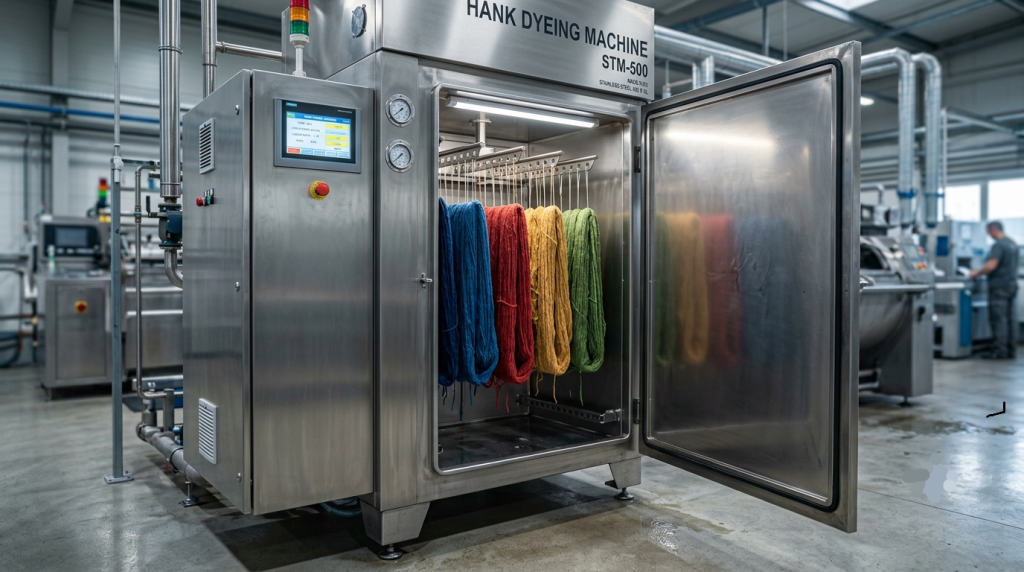
Hank dyeing—often used synonymously with skein dyeing—represents one of the oldest, most delicate, and technologically refined methods of applying coloration to yarn. Unlike package dyeing, where yarn is tightly wound onto perforated plastic or stainless-steel cones under high density, a hank dyeing machine processes yarn in loose, looped coils known as hanks or skeins.
In modern textile manufacturing, maintaining the physical integrity, loft, surface appearance, and bulkiness of natural and synthetic fibers is paramount. High-bulk acrylics, fine mulberry silks, cashmere, mohair, mercerized combed cotton, and carpet-grade wools suffer significant structural collapse, surface chafing, and loss of elasticity when subjected to the high-compression forces of package winding and high-differential-pressure liquor flow.
                     +---------------------------------------+
                     |         Yarn Reeling Process          |
                     |     (Cones converted to Loose Hanks)  |
                     +-------------------+-------------------+
                                         |
                                         v
                     +---------------------------------------+
                     |   Pre-Treatment & Scouring/Mercerizing |
                     +-------------------+-------------------+
                                         |
                                         v
                     +---------------------------------------+
                     |  Hank Dyeing Machine Processing       |
                     |  (Cabinet / Spray / Hussong / HTHP)   |
                     +-------------------+-------------------+
                                         |
                                         v
                     +---------------------------------------+
                     |   Hydro-Extraction (Centrifugal De-water)|
                     +-------------------+-------------------+
                                         |
                                         v
                     +---------------------------------------+
                     |  Conditioning & Drying (Pole Dryer)   |
                     +-------------------+-------------------+
                                         |
                                         v
                     +---------------------------------------+
                     |   Hank-to-Cone Re-winding (For Use)   |
                     +---------------------------------------+
A specialized hank dyeing machine operates under minimal physical tension. By permitting the individual filaments and fibers to float or remain suspended freely in a moving liquor, the hank dyeing machine guarantees total dye liquor penetration to the core of the yarn, yielding unexcelled depth of shade, superior levelness, and an uncompromised soft hand-feel.
2. Classification and Structural Anatomy of Hank Dyeing Machines
A contemporary hank dyeing machine can be broadly categorized according to its structural geometry, pressure rating, and liquor circulation mechanisms. Choosing the correct hank dyeing machine depends on fiber morphology, thermal resistance, and batch size requirements.
                                  +-----------------------------+
                                  | Hank Dyeing Machine Family  |
                                  +--------------+--------------+
                                                 |
         +------------------+--------------------+--------------------+-------------------+
         |                  |                                         |                   |
         v                  v                                         v                   v
+------------------+ +------------------+                      +------------------+ +------------------+
| Hussong Type     | | Cabinet Type     |                      | Spray Arm Type   | | HTHP Type        |
| (Open Vat / Box) | | (Enclosed System)|                      | (Rotating Pegs)  | | (Pressurized)  |
+------------------+ +------------------+                      +------------------+ +------------------+
2.1 Hussong / Open Vat Hank Dyeing Machine

The Hussong-type hank dyeing machine is the historical benchmark for skein processing. It consists of a large, open rectangular stainless-steel vat featuring a false perforated bottom and an isolated drive chamber hosting a reversible axial-flow impeller.
+------------------------------------------------------------------+
|                  Hussong Hank Dyeing Machine                     |
|                                                                  |
|   +----------------------------------------------------------+   |
|   |                  Removable Carrier Frame                 |   |
|   |   +------+     +------+     +------+     +------+        |   |
|   |   | Top  |     | Top  |     | Top  |     | Top  |        |   |
|   |   | Stick|     | Stick|     | Stick|     | Stick|        |   |
|   |   +--+---+     +--+---+     +--+---+     +--+---+        |   |
|   |      |            |            |            |            |   |
|   |    (Skein)      (Skein)      (Skein)      (Skein)        |   |
|   |      |            |            |            |            |   |
|   |   +--+---+     +--+---+     +--+---+     +--+---+        |   |
|   |   |Bottom|     |Bottom|     |Bottom|     |Bottom|        |   |
|   |   | Stick|     | Stick|     | Stick|     | Stick|        |   |
|   |   +------+     +------+     +------+     +------+        |   |
|   +----------------------------------------------------------+   |
|   ~~~~~~~~~~~~~~~~~~~~~~~~~~~~~~~~~~~~~~~~~~~~~~~~~~~~~~~~~~~~   |
|   ~~~~~~~~~~~~~~~ Liquors / Dyebath Level ~~~~~~~~~~~~~~~~~~~~   |
|   ============================================================   |
|                    Perforated False Bottom                       |
|   ------------------------------------------------------------   |
|     Heating Coil  |  Reversible Axial Impeller -> [Driven]       |
+------------------------------------------------------------------+
- Single-Stick System: Yarns hang freely from upper removable sticks. Upward liquor flow lifts the skeins, which can cause tangling if velocity is uncontrolled.
- Two-Stick System: Yarns are mounted between upper and lower sticks. The lower stick restrains vertical displacement, permitting higher liquor circulation velocities without entangling fine counts.
- Stick-Marking Mitigation: Sticks feature profile-extruded triangular or V-shaped cross-sections with smooth perforations. This shape minimizes contact points where dye absorption might otherwise lag.
2.2 Cabinet-Type Hank Dyeing Machine
The cabinet hank dyeing machine encloses the process inside a sealed stainless-steel vessel designed for operating temperatures up to 98°C–100°C.
+--------------------------------------------------------------------+
|                Cabinet Type Hank Dyeing Machine                    |
|                                                                    |
|  +--------------------------------------------------------------+  |
|  | [Door Seal]               CABINET CHAMBER                    |  |
|  |                                                              |  |
|  |   Upper Perforated Support Bar (Fixed / Adjustable)          |  |
|  |   ========================================================   |  |
|  |        ||              ||              ||              ||    |  |
|  |        ||              ||              ||              ||    |  |
|  |      Yarn            Yarn            Yarn            Yarn    |  |
|  |      Skein           Skein           Skein           Skein   |  |
|  |        ||              ||              ||              ||    |  |
|  |        ||              ||              ||              ||    |  |
|  |   ========================================================   |  |
|  |   Lower Perforated Support Bar                               |  |
|  +--------------------------------------------------------------+  |
|  | High-Flow Reversible Pump  <===> Heat Exchanger (Internal)   |  |
+--------------------------------------------------------------------+
The yarn carrier is loaded externally and rolled on tracks directly into the cabinet. Perforated carrier arms connect to main liquor manifolds, pushing dye liquor vertically through the hanks in alternating top-to-bottom and bottom-to-top cycles. This directional control protects delicate fibers like cashmere, fine botany wool, and silk from surface felting or distortion.
2.3 Spray/Cascade Arm Hank Dyeing Machine

Designed for high-value delicate yarns (e.g., pure mulberry silk, filament nylon, viscose), the spray hank dyeing machine hangs yarn on horizontal perforated arms.
+--------------------------------------------------------------------+
|               Spray/Cascade Arm Hank Dyeing Machine                |
|                                                                    |
|           +---------------------------------------------+          |
|           | Dye Liquor Supply Pipe (Controlled Pressure)|          |
|           +----------------------+----------------------+          |
|                                  |                                 |
|                    +-------------v-------------+                   |
|                    | Outer Perforated Spray Arm|                   |
|                    +--------------+------------+                   |
|                                   | (Cascading Liquid Film)        |
|                                   v                                |
|                           +---------------+                        |
|                           |  Yarn Hank    |  (Slow Rotation        |
|                           |  Suspended    |   of Arm 1-3 RPM)      |
|                           +---------------+                        |
|                                   |                                |
|                                   v                                |
|                   +-------------------------------+                |
|                   | Bottom Collector Trough/Sump  |                |
|                   +---------------+---------------+                |
|                                   |                                |
|                                   v                                |
|               Heat Exchanger --> Circulation Pump                  |
+--------------------------------------------------------------------+
Liquor pumps into the hollow core of each arm and sprays through calculated perforations, forming a smooth liquid film over the skein. Simultaneously, the support arms rotate slowly (1–3 RPM). This continuous rotation shifts the yarn contact points, completely eliminating stick marks while preventing filament friction.
2.4 High-Temperature High-Pressure (HTHP) Hank Dyeing Machine
For synthetic fibers such as 100% polyester, modified acrylics, and structural blends, standard atmospheric boiling points are insufficient to open the polymer's crystalline regions.
+--------------------------------------------------------------------+
|               HTHP Hank Dyeing Machine (P = 3.5-4.0 Bar)            |
|                                                                    |
|    /----------------------------------------------------------\    |
|   /    Heavy-Duty Stainless Steel Pressure Vessel (AISI 316L)  \   |
|  |   +------------------------------------------------------+   |  |
|  |   |                  Internal Carrier                    |   |  |
|  |   |    [Top Arm]  <=== Pressurized Liquor Flow           |   |  |
|  |   |        |                                             |   |  |
|  |   |      (Hank)   (Temp: Up to 135°C / 275°F)            |   |  |
|  |   |        |                                             |   |  |
|  |   |    [Bottom Arm] ===> Return Drain                    |   |  |
|  |   +------------------------------------------------------+   |  |
|   \  ======================================================    /   |
|    \-----[ Quick-Lock Safety Door ]-----[ External Heat Exch]--/    |
+--------------------------------------------------------------------+
An HTHP hank dyeing machine utilizes an autoclave-grade cylindrical pressure vessel engineered to withstand 135°C (275°F) at operating pressures of 3.5 to 4.0 bar. These systems rely on high-capacity mixed-flow pumps and specialized heat exchangers to run precise thermal ramp schedules without causing oligomer precipitation or yarn shrinkage.
3. Structural Comparison of Major Machine Types
| Technical Parameter | Hussong / Open Vat Machine | Cabinet Type Machine | Spray / Cascade Machine | HTHP Hank Machine |
| Max Working Temp | 98°C (Atmospheric) | 98°C – 102°C | 98°C (Atmospheric) | 135°C – 140°C |
| Max Working Pressure | Ambient | Ambient / Slight Overpressure | Ambient | 3.5 – 4.5 Bar |
| Liquor Ratio (L:R) | 1:15 to 1:25 | 1:8 to 1:12 | 1:12 to 1:18 | 1:7 to 1:10 |
| Ideal Fibers | Coarse Wool, Carpet Yarn, Acrylic | Botany Wool, Cashmere, Mercerized Cotton | Pure Silk, Nylon Filament, Viscose Rayon | Polyester, Microfiber, Polyester Blends |
| Mechanical Tension | Very Low | Moderate / Restricted | Ultra-Low / Floating | Restricted |
| Energy Footprint | High heat radiation losses | Moderate / Insulated cabinet | Moderate | High initial steam, highly efficient cycle |
| Batch Capacity Range | 50 kg – 500 kg | 20 kg – 450 kg | 10 kg – 250 kg | 25 kg – 300 kg |
4. Mechanical & Electrical Subsystems Architecture
Modern industrial hank dyeing machine platforms integrate advanced mechanical, fluidic, and electronic control assemblies.
+-------------------------------------------------------------------+
|            Integrated Subsystems of a Modern Machine              |
+-------------------------------------------------------------------+
|  1. Fluid Dynamics & Pump Subsystem                               |
|     - Reversible Axial/Mixed-Flow Impellers                       |
|     - Variable Frequency Drives (VFD Speed Regulation)            |
+-------------------------------------------------------------------+
|  2. Thermal Energy & Heat Transfer Subsystem                      |
|     - External Shell-and-Tube Heat Exchangers                     |
|     - Closed Pneumatic Steam Valves & Condensate Traps            |
+-------------------------------------------------------------------+
|  3. Structural Carrier Assembly                                   |
|     - AISI 316L Stainless Steel Construction                      |
|     - Micro-Polished V-Profile Suspended Perforated Rods          |
+-------------------------------------------------------------------+
|  4. Automation & Process Control Unit                             |
|     - PLC Logic Engine with Microprocessor Touchpanel             |
|     - PT100 Temperature Sensors & Differential Pressure Transducer|
+-------------------------------------------------------------------+
4.1 Frame, Vessel, and Material Specifications
The structural chassis and all wetted components of a high-performance hank dyeing machine are fabricated from AISI 316L molybdenum-stabilized stainless steel. This alloy resists pitting and stress corrosion cracking from organic acids, reactive dyes, electrolytic salts, and high-temperature liquor environments. Internal surfaces undergo electropolishing to reach a roughness average ($R_a$) below $0.4\,\mu\text{m}$, which prevents mechanical abrasion on fine fibers.
4.2 Circulation Pumps and Fluid Inversion
Dye liquor movement is driven by custom-engineered mixed-flow or axial-flow pumps running off Variable Frequency Drives (VFDs). Reversing the liquor flow direction at programmed intervals prevents channeling and guarantees uniform exhaustion throughout the hank bundle.
Flow Inversion Timing Cycle (Example for Level Reactive Dyeing)
===================================================================
Top-to-Bottom Flow (Out-In) :  |████████████████| 6.0 Minutes
Dwell/Inversion Pause       :  |==| 0.2 Minutes
Bottom-to-Top Flow (In-Out) :  |████████████████| 6.0 Minutes
Dwell/Inversion Pause       :  |==| 0.2 Minutes
4.3 Heating and Cooling Assemblies
Direct steam injection causes liquor dilution and local temperature spikes that risk unleveled dye uptake. Modern machines use indirect heat exchangers constructed from seamless AISI 316L tubes. Modulated pneumatic valves regulate steam and cooling water flow to precisely maintain target heating (e.g., $1.5^\circ\text{C/min}$) and cooling gradients.
Indirect Shell-and-Tube Heat Exchanger Topology
===================================================================
Steam Input (Pneumatic Valve) ──> [ Internal Tube Bundle ] ──> Condensate Trap
                                         │
Dye Liquor In ──> [ External Shell / Counter-Current Flow ] ──> Dye Liquor Out
5. Process Engineering, Flow Control, and Operations
Operating an industrial hank dyeing machine requires precise control over each phase of the production sequence.
+-------------------------------------------------------------------+
|               End-to-End Hank Processing Sequence                 |
+-------------------------------------------------------------------+
| 1. Reeling Phase                                                  |
|    - Converted from packages to target perimeter (1.35m - 1.50m)  |
|    - Cross-winding angle calibrated to prevent tight density      |
+-------------------------------------------------------------------+
| 2. Scouring, Bleaching & Mercerization                            |
|    - Removes natural waxes, oils, and structural impurities       |
|    - Optional caustic alkali bath increases luster and dye affinity|
+-------------------------------------------------------------------+
| 3. Loading Phase                                                  |
|    - Skeins mounted symmetrically on perforated support sticks     |
|    - Equal mass per stick ensures balanced flow distribution      |
+-------------------------------------------------------------------+
| 4. Dyeing Cycle                                                   |
|    - Precise ramp-up, holding dwell, and controlled cooling       |
|    - Salt/alkali dosing via micro-metering additions tank         |
+-------------------------------------------------------------------+
| 5. Post-Treatment & Rinsing                                       |
|    - Unreacted dye removal, neutralization, and softening step    |
+-------------------------------------------------------------------+
| 6. Hydro-Extraction & Pole Drying                                 |
|    - Centrifugal de-watering down to ~40-50% residual moisture    |
|    - Continuous pole drying preserves loft and bulkiness          |
+-------------------------------------------------------------------+
5.1 Reeling and Skein Preparation

The geometry and density of the hank dictate liquor permeability. Yarn is transferred from spinning packages onto reeling machines to produce hanks of fixed lengths—typically 1.35 to 1.50 meters.
  +---------------------------------------------------------------+
  |                 Lease Banding Configuration                   |
  |                                                               |
  |       =================================================       |
  |      //  Skein Band 1   Skein Band 2   Skein Band 3   \\      |
  |     ||     (Loop)         (Loop)         (Loop)        ||     |
  |     ||       ||             ||             ||          ||     |
  |     ||     +----+         +----+         +----+        ||     |
  |      \\    |    |         |    |         |    |       //      |
  |       =====|====|=========|====|=========|====|=======        |
  |            +----+         +----+         +----+               |
  |          Figure-8       Figure-8       Figure-8               |
  |         Lease Tie      Lease Tie      Lease Tie               |
  +---------------------------------------------------------------+
Lease bands must be tied in a loose figure-eight pattern around the hanks. Over-tightening causes white tie-marks where dye cannot penetrate, while under-tightening allows threads to tangle during pump cycles.
5.2 Loading and Mass Distribution
Skein weight per stick must be calculated precisely. Overloading causes liquor channeling around the edges of the bundle, leaving the center un-dyed. Conversely, under-loading lets the liquor bypass the yarn, resulting in low pump efficiency and irregular dye uptake.
6. Dyeing Chemistry and Fiber-Specific Recipes
A hank dyeing machine accommodates various dye classes tailored to specific fiber substrates.
6.1 Reactive Dyeing on Mercerized Cotton
Mercerized cotton hanks require careful dosing of electrolyte (glauber's salt) and alkali (soda ash) to achieve level exhaustion and fixation without causing streaks.
Reactive Dyeing Thermal Profile (Exhaust Method)
===================================================================
Temp (°C)
 80°C |                                    /--------------------\  Fixation Dwell (45-60 min)
      |                                   /                      \
 60°C |           /----------------------/                        \
      |          /   Salt Addition                                 \
 30°C |---------/                                                   \--------
      +-----------------------------------------------------------------------> Time
       Load & Add  Ramp 1.5°C/min  Add Alkali                        Cool down
       Dyes & Aux                  (Fixation)                        (1.5°C/min)
Formula: Reactive Dyes on Cotton Hank (100 kg Batch)
-------------------------------------------------------------------
- Reactive Dye (e.g., Reactive Blue 21) : 2.5% OWF (On Weight of Fiber)
- Sodium Sulfate (Glauber's Salt)       : 60 g/L
- Sodium Carbonate (Soda Ash)           : 15 g/L
- Sequestering Agent                    : 1.0 g/L
- Non-ionic Wetting Agent               : 1.0 g/L
- Liquor Ratio                          : 1:10
6.2 Acid Dyes on Mulberry Silk and Wool
Protein fibers are sensitive to high alkalinity and extreme temperatures. Acid dyes bond via ionic interactions with the fiber's amine groups.
Formula: Acid Dyeing on Silk/Wool (100 kg Batch)
-------------------------------------------------------------------
- Acid Dye (e.g., Acid Blue 25)         : 1.2% OWF
- Ammonium Sulfate (pH Regulator)       : 2.0 g/L
- Levelling Agent (Amphoteric)          : 1.0 g/L
- Acetic Acid (98%)                     : Adjust bath pH to 4.5 – 5.0
- Temperature Profile                   : Ramp from 40°C to 95°C at 1.0°C/min
- Dwell Time                            : 45 minutes at 95°C
6.3 Disperse Dyeing on Polyester in HTHP Systems
Polyester hanks require pressurized dyeing above $100^\circ\text{C}$ to allow disperse dye molecules to diffuse into the fiber structure.
Formula: Disperse Dyeing on High-Bulk Polyester (100 kg Batch)
-------------------------------------------------------------------
- Disperse Dye (e.g., Disperse Red 60)  : 1.8% OWF
- Dispersing Agent                      : 1.5 g/L
- Acetic Acid (pH Control)              : Adjust bath pH to 4.5 – 5.0
- Carrier (Optional for low-temp)       : 0.0 g/L (HTHP mode)
- Peak Temperature                      : 130°C at 3.0 Bar pressure
- Dwell Time                            : 60 minutes
7. Mathematical Modeling, Thermodynamics, and Fluid Mechanics
To quantify liquor behavior inside a hank dyeing machine, process engineers apply core fluid dynamic and thermodynamic formulas.
+-------------------------------------------------------------------+
|               Mathematical & Engineering Framework                |
+-------------------------------------------------------------------+
|  1. Darcy's Law for Fluid Flow through Porous Media               |
|     Q = (K * A * dP) / (u * L)                                    |
|     - Models dye liquor flow through packed yarn bundles          |
+-------------------------------------------------------------------+
|  2. Mass Transfer Rate & Dye Absorption Dynamics                  |
|     dC/dt = k_m * A_s * (C_bath - C_surface)                      |
|     - Calculates mass transfer across boundary layer              |
+-------------------------------------------------------------------+
|  3. Thermal Energy & Steam Consumption Analysis                   |
|     Q_total = [m * C_p * dT] + Q_loss                             |
|     - Determines total heat energy required for bath ramp        |
+-------------------------------------------------------------------+
7.1 Hydrodynamics of Flow Through Porous Media
The yarn hank bundle acts as an anisotropic porous medium. The volume flow rate $Q$ through a compressed hank matrix is modeled using Darcy's Law:
$$Q = \frac{K \cdot A \cdot \Delta P}{\mu \cdot L}$$
Where:
- $Q$ = Volumetric flow rate ($\text{m}^3/\text{s}$)
- $K$ = Specific permeability of the yarn skein ($\text{m}^2$)
- $A$ = Cross-sectional area perpendicular to fluid movement ($\text{m}^2$)
- $\Delta P$ = Differential pressure drop across the hank ($\text{Pa}$)
- $\mu$ = Dynamic viscosity of the dye liquor ($\text{Pa}\cdot\text{s}$)
- $L$ = Effective thickness/path length of the skein layer ($\text{m}$)
If packing density rises beyond optimal thresholds, permeability $K$ drops exponentially, forcing $\Delta P$ upward and increasing the risk of liquor channeling.
7.2 Kinetics of Dye Mass Transfer
The mass transfer rate ($dC/dt$) of dye molecules from the main liquor body onto the fiber surface is governed by Fick's First Law and boundary layer mass transport equations:
$$\frac{dC}{dt} = k_m \cdot A_s \cdot (C_{\text{bath}} – C_{\text{surface}})$$
Where:
- $k_m$ = Mass transfer coefficient ($\text{m/s}$)
- $A_s$ = Total surface area of individual fibers in the hank ($\text{m}^2$)
- $C_{\text{bath}}$ = Instantaneous dye concentration in the bulk liquor ($\text{kg/m}^3$)
- $C_{\text{surface}}$ = Dye concentration at the fiber interface ($\text{kg/m}^3$)
7.3 Thermal Energy and Steam Consumption
The energy ($Q_{\text{total}}$) required to heat a hank dyeing machine bath from initial temperature $T_1$ to peak temperature $T_2$ is expressed as:
$$Q_{\text{total}} = (m_{\text{liquor}} \cdot C_{p,\text{water}} + m_{\text{steel}} \cdot C_{p,\text{steel}}) \cdot (T_2 – T_1) + Q_{\text{radiation loss}}$$
Where:
- $m_{\text{liquor}}$ = Mass of dye bath liquor ($\text{kg}$)
- $m_{\text{steel}}$ = Mass of wetted machine steel ($\text{kg}$)
- $C_p$ = Specific heat capacity ($\text{kJ/kg}\cdot^\circ\text{C}$)
8. Global Research, Innovations, and Sustainable Developments
Researchers and machinery OEMs continue to innovate hank dyeing machine technology, focusing on reducing energy consumption, water use, and process variations.
+-------------------------------------------------------------------+
|               Global Research & Innovation Vectors                |
+-------------------------------------------------------------------+
|  1. Low Liquor Ratio Engineering (Ultra-Low L:R 1:5 - 1:7)       |
|     - Internal displacement volume inserts                        |
|     - Air-assisted misting spray arms                             |
+-------------------------------------------------------------------+
|  2. Eco-Friendly Cavitation & Sonic Dyeing                        |
|     - Sonotrode micro-streaming breaks dye agglomerates           |
|     - Reduces processing temperature by 15-20°C                   |
+-------------------------------------------------------------------+
|  3. Digital Twin & Predictive Industry 4.0 Controllers            |
|     - Real-time spectrophotometry for automated exhaustion control|
|     - Closed-loop pump speed adaptation via differential pressure |
+-------------------------------------------------------------------+
8.1 Ultra-Low Liquor Ratio (ULLR) Technology
Traditional hank dyeing machines operated at high liquor ratios (1:15 to 1:25), requiring large amounts of water, steam, and processing chemicals. Modern engineering advances have lowered liquor ratios down to 1:5 – 1:8 through:
- Contoured Internal Cabinets: Redesigning internal vessel walls to eliminate dead volume zones.
- Air-Assisted Spray Technology: Injecting low-pressure air into the spray stream to distribute dye evenly using less liquid volume.
8.2 Ultrasonic-Assisted Hank Dyeing
Global research initiatives have investigated integrating ultrasonic transducers into the hank dyeing machine chamber. Ultrasound creates acoustic cavitation—microscopic bubble formation and collapse—in the dye liquor.
                     Acoustic Cavitation Mechanics
                      =============================
   [Ultrasound Wave] ──> Micro-Bubble Formation ──> Violent Collapse
                                                         │
   Enhanced Diffusion <── Breakdown of Boundary Layer <──┘
Benefits include:
- Reduces required dyeing temperatures by $15^\circ\text{C}$ to $20^\circ\text{C}$.
- Accelerates dye penetration into high-density yarn bundles.
- Decreases processing time by up to 30%, conserving steam energy.
8.3 IoT, Automation, and Real-Time Spectrophotometry
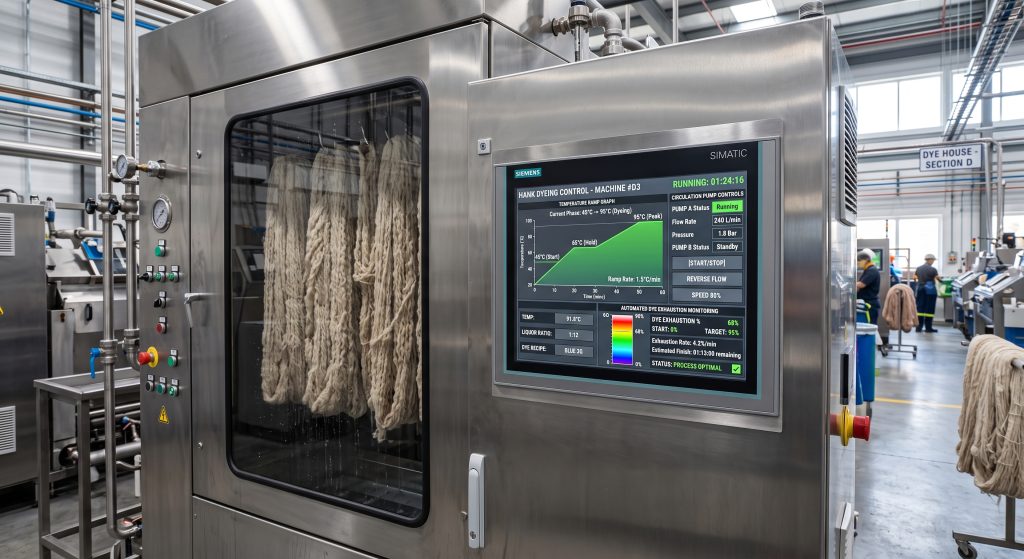
Modern industrial units feature PLC systems connected to online spectrophotometers. These sensors continuously monitor dye liquor absorbance, allowing the system to adjust temperature gradients dynamically based on real-time exhaustion rates rather than static timers.
+-------------------------------------------------------------------+
|              Automated Closed-Loop Control Architecture           |
+-------------------------------------------------------------------+
|  [In-Line Optical Sensor] --> Real-Time Liquor Absorbance Data    |
|                                       │                           |
|                                       v                           |
|  [PLC Controller] <-------- Analyzes Exhaustion Rate Curve        |
|        │                                                          |
|        ├──> Adjusts Steam Valve (Thermal Gradient Rate)           |
|        └──> Adjusts VFD Inverter (Pump Circulation RPM)          |
+-------------------------------------------------------------------+
9. Comprehensive Troubleshooting & Defects Analysis
Preventing defects in a hank dyeing machine requires systematic root-cause analysis. Below is an industrial troubleshooting guide for common processing issues:
                                Defect Identification Tree
                                ==========================
                                            │
        ┌───────────────────────────────────┼──────────────────────────────────┐
        │                                   │                                  │
        v                                   v                                  v
+---------------+                   +---------------+                  +---------------+
| Unlevelness/  |                   | Stick Marks & |                  | Filament      |
| Color Spots   |                   | Hard Lines    |                  | Tangling      |
+-------+-------+                   +-------+-------+                  +-------+-------+
        │                                   │                                  │
        ├─> Low Flow/RPM                    ├─> Frozen Support Peg             ├─> Excessive Flow
        ├─> Rapid Salt Addition             ├─> Overloaded Carrier             ├─> Incorrect Ties
        └─> Chemical Precipitation          └─> Static Contact Zone            └─> High Impeller RPM
| Defect Type | Root Cause Analysis | Corrective Action & Prevention |
| Unlevel / Patchy Dyeing | • Inadequate liquor circulation velocity. • Dyes added too quickly during ramp phase. • Temperature gradient too steep ($>2^\circ\text{C/min}$). | • Increase pump VFD output. • Implement micro-metered progressive dosing for salts/alkalis. • Reduce heating rate to $1.0^\circ\text{C} - 1.5^\circ\text{C/min}$. |
| Stick / Bar Marking | • Yarn remained static on support sticks without movement. • Overloaded carrier sticks restricting liquor flow. • Sharp, damaged stick edges. | • Use rotating stick drives or V-profile perforated bars. • Maintain correct yarn loading weight per meter. • Inspect and electropolish all support sticks. |
| Yarn Tangling & Felting | • Reversible pump frequency set too high. • Loose or missing figure-eight lease ties. • Turbulent top-to-bottom flow in open-vat designs. | • Reduce pump RPM during sensitive steps. • Standardize lease tie counts (min. 4 per hank). • Use two-stick cabinet systems to secure delicate fibers. |
| Skein-to-Skein Shade Variation | • Unequal liquor distribution across cabinet arms. • Clogged spray arm perforations. • Variable hank reel perimeters. | • Clean pump spray manifolds regularly. • Balance yarn weight across every carrier arm. • Standardize reeling tensions on supply machines. |
| Loss of Yarn Bulk & Loft | • Over-stretching on two-stick carrier systems. • Excessive thermal exposure under high pressure. | • Maintain a $3-4\text{ cm}$ clearance gap on bottom sticks. • Optimize peak dwell times to prevent thermal fiber collapse. |
10. Preventive Maintenance and Operational Safety
Routine maintenance keeps a hank dyeing machine operating efficiently while protecting mill personnel.
+-------------------------------------------------------------------+
|             Preventive Maintenance Protocol Matrix                |
+-------------------------------------------------------------------+
| Daily Protocols                                                   |
| - Inspect pneumatic door safety seals and locking pins            |
| - Flush spray arm orifices and drain sumps                        |
+-------------------------------------------------------------------+
| Weekly Protocols                                                  |
| - Check mechanical pump shaft seals for leakage                   |
| - Calibrate PT100 temperature sensors against reference standards |
+-------------------------------------------------------------------+
| Monthly Protocols                                                 |
| - Inspect heat exchanger tubes for scale buildup; descaling flush |
| - Audit VFD drive parameters and motor current draw               |
+-------------------------------------------------------------------+
| Semi-Annual Protocols                                             |
| - Hydrostatic pressure test on HTHP vessel walls                  |
| - Polish yarn support sticks and repair damaged chrome coatings   |
+-------------------------------------------------------------------+
Safety Interlocks on HTHP Systems
To prevent industrial accidents, HTHP machines feature triple safety interlocks:
- Pressure Switch Interlock: Mechanical door remains locked whenever internal pressure exceeds $0.05\text{ bar}$.
- Thermal Limit Interlock: Safety lock remains engaged if liquor temperature exceeds $80^\circ\text{C}$.
- Liquor Level Sensor: Prevents heating elements from activating unless the vessel reaches safe fluid levels, avoiding dry-burn damage.
11. Techno-Economic Evaluation & Comparison
When investing in yarn dyeing equipment, mill managers evaluate capital expenditure (CAPEX), operational costs (OPEX), process versatility, and finished product quality.
Cost Element Comparison (Cabinet Hank vs. Package Dyeing)
===================================================================
Cabinet Hank Dyeing Machine : [CapEx: Med] [OpEx: High] [Quality/Loft: Superior]
Cone Package Dyeing Machine : [CapEx: High] [OpEx: Low]  [Quality/Loft: Moderate]
+-------------------------------------------------------------------+
|               Techno-Economic Decision Matrix                     |
+-------------------------------------------------------------------+
| Factor               | Hank Dyeing System  | Package Dyeing System |
+----------------------+---------------------+----------------------+
| Initial CAPEX        | Moderate            | High                 |
| Energy/Steam Cost    | Higher (Higher L:R) | Lower (Low L:R)      |
| Labor Intensity      | Higher (Reeling)    | Lower (Direct Winding)|
| Softness / Loft      | Maximum Retained    | Compressed           |
| High-Bulk Acrylic    | Outstanding         | Moderate / Poor      |
| Mulberry Silk        | Optimal             | Not Recommended      |
+-------------------------------------------------------------------+
12. Conclusion
The modern hank dyeing machine remains an essential technology in high-value textile manufacturing. While automated package dyeing handles high-volume commodity yarns, hank processing is irreplaceable when preserving fiber loft, bulk, elasticity, and surface quality.
Driven by innovations in low liquor ratio cabinets, automated spray arms, ultrasonic agitation, and closed-loop process automation, the hank dyeing machine continues to evolve. Understanding the mechanical design, thermodynamics, chemistry, and troubleshooting of these machines allows textile engineers to maximize quality, reduce environmental impact, and optimize cost-efficiency across all skein-dyeing operations.
References
- Shore, J. (2002). Blending Color: Theory and Practice of Textile Dyeing. Society of Dyers and Colourists.
- Broadbent, A. D. (2001). Basic Principles of Textile Coloration. Society of Dyers and Colourists.
- Textile Learner. Different Types of Hank Dyeing Machine. Available online: https://textilelearner.net/hank-dyeing-machine/
- Forbes Marshall Industrial Solutions. Hank Dyeing Machines and Steam System Optimization. Available online: https://www.forbesmarshall.com/industries/textile-industry/hank-dyeing-machines/
- MB Trade BD. Industrial Hank Yarn Dyeing Machine Technical Specifications. Available online: https://www.mbtradebd.com/product/hank-yarn-dyeing-machine-2/
- Singularity Textile Technologies. Uses, Benefits and Techniques of Industrial Hank Dyeing Machines. Available online: https://www.shhsingularity.com/blog/hank-dyeing-machine-uses-benefits-techniques/
- Carbonell, J. (1998). Optimizing Fluid Dynamics in Skein and Hank Processing Equipment. Journal of the Society of Dyers and Colourists, 114(4), 112-120.
- Yang, Y., & Li, S. (2018). Energy Efficiency and Water Reduction in Low-Liquor Ratio Yarn Dyeing Systems. Cleaner Production Journal, 182, 455-463.
Frequently Asked Questions (FAQ)
Q1: What is a hank dyeing machine, and why is it preferred over package dyeing?
A hank dyeing machine dyes yarn in loose, looped coils (hanks or skeins). It is preferred for delicate, high-bulk, or premium yarns (wool, silk, cashmere, acrylic) because it applies minimal tension during processing. This preserves the fiber's natural softness, elasticity, bulkiness, and hand-feel better than high-density package dyeing.
Q2: Which fibers are best suited for a hank dyeing machine?
A hank dyeing machine is ideal for high-bulk acrylics, pure botany wool, mohair, cashmere, mulberry silk, mercerized cotton, fine linen, and carpet yarns.
Q3: What is the main cause of stick marking in a hank dyeing machine?
Stick marking occurs where the yarn rests continuously against the support stick, restricting dye liquor flow and absorption at that contact point. You can prevent it by using rotating support sticks, perforated V-profile bars, or spray-arm systems that slowly rotate the hanks throughout the cycle.
Q4: How does an HTHP hank dyeing machine differ from atmospheric cabinet machines?
An atmospheric cabinet hank dyeing machine operates up to 98°C–100°C under open or ambient conditions, making it suitable for natural fibers and acrylics. An HTHP hank dyeing machine uses a sealed pressure vessel operating up to 135°C at 3.5–4.0 bar pressure, which is required to dye synthetic fibers like polyester.
Q5: How can a mill reduce water and steam consumption in a hank dyeing machine?
Resource use can be reduced by using modern low-liquor-ratio (ULLR) cabinet designs, installing indirect heat exchangers with effective condensate recovery, retrofitting VFDs on circulation pumps, and optimizing batch weight distributions.

Md. Safayet Siddique is a seasoned textile professional with over 14 years of extensive experience in textile wet processing, dyeing, and finishing. A graduate of Bangladesh University of Textiles (BUTEX), he combines strong academic knowledge with deep industry expertise to deliver practical, results-driven insights in textile manufacturing.
Throughout his career, Safayet has developed a high level of specialization in wet processing technologies, including dyeing techniques, process optimization, quality assurance, and production efficiency. His hands-on experience across the textile value chain has enabled him to understand the complexities of modern textile operations and implement effective, real-world solutions.
Beyond his professional work, Safayet is deeply committed to knowledge sharing and industry education. As the founder of TextileEdu, he is building a trusted platform dedicated to simplifying textile engineering concepts and providing valuable resources for students, professionals, and industry learners worldwide.
His vision is to empower the next generation of textile professionals by bridging the gap between theoretical learning and industrial practice, while contributing to the continuous development of the global textile industry.


